
On February 28th, 2026, rockets could be heard over Tehran. On that day the US military in cooperation with their Israeli allies launched a first strike missile attack against the Islamic Republic of Iran. People watched in horror as loved ones were buried under the rubble or shredded by bombs. Those hoping to escape the destruction hid in their homes, though no place was safe. Military bases and schools alike were hit. When the dust settled many searched the wreckage. Some found the lifeless bodies of those they cared for, others did not.
This scene is not an uncommon occurrence. In January the US invaded Venezuela, kidnapping the nation’s president and murdering 80 people. It has since strengthened the embargo on Cuba, cutting the Island nation off from oil, which is critical for the functioning of essential services like hospitals, leading to many unnecessary deaths. US actions across the globe have led to the suffering of millions of people.
Maine is a part of the United States though few people consider our state’s involvement in foreign policy. However, Maine is deeply connected to the lives of people abroad. Not in some abstract way, but materially and directly through what our state funds and supports. This article hopes to show how Maine is not simply a passive supporter by merely being a part of the US, but is in fact an active participant in the horrors wrought abroad, and how there is a direct connection between Maine and these conflicts. It does not have to be this way. While massive political upheaval would need to occur in the US as a whole, there are steps we can take within our state to mitigate its involvement in the US war machine.
To start off, we should understand Maine’s involvement with the US military. As of fiscal year 2024, the US military spends about 4.6 billion dollars in Maine. This is around 4.7 percent of the state’s GDP. Out of the major nations being threatened by the US right now, Maine’s military expenses are around 60% of the total military expenses of Iran. The amount spent on the US military in Maine alone is over 9 times that of Venezuela and over 35 times that of Cuba. Maine dwarfs these nations regarding military spending. Maine itself only makes up around 0.8 percent of total US military spending. To reiterate, less than 1% of the US military is enough to outspend Cuba’s military 35 times over. Yet they are still somehow considered a national security threat where we must starve its people to death in order to protect America.
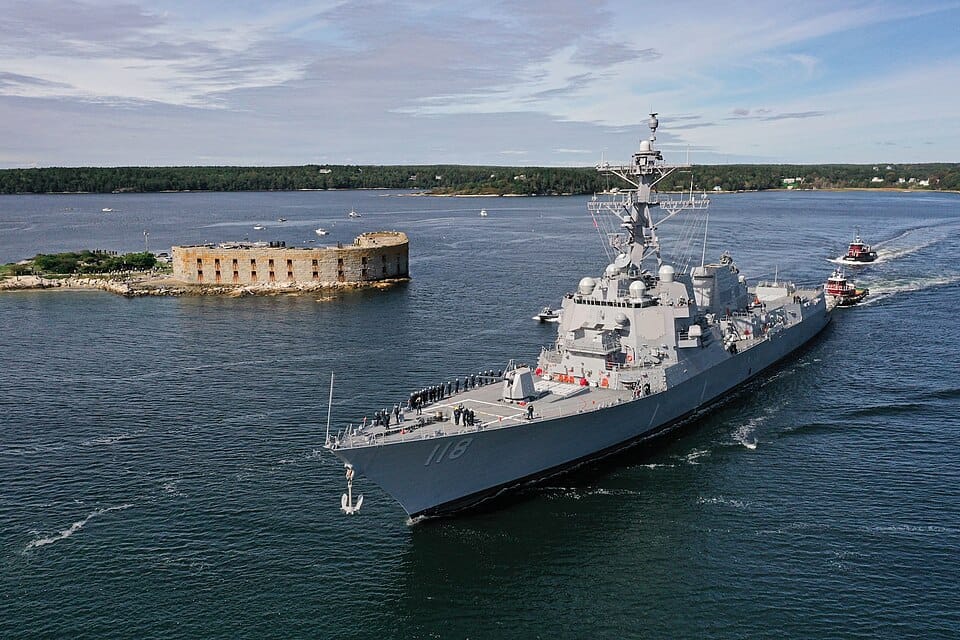
With all this money being pumped into Maine, where is it actually going? General Dynamics is one of the major military contractors in the state. It is the fourth largest military contractor in the US. In 2024 the US government gave it 191 million for an army contract in Saco. The company owns Bath Iron Works (BIW), which is another major player in the Maine economy. In 2025 BIW was the fourth largest private employer in the state ranging from 6,000 to 6,500 employees. It has been producing ships for the US military since 1884 and was bought by General Dynamics in 1995. It produces around half of all Arleigh Burke-Class Destroyers. As of 2019 BIW supports 69 ships which is around 75% of the nation’s surface combatants.
Texas Instruments, the other major corporation producing for the military, has been operating in Maine since 2011 when it purchased National Semiconductor. Texas Instruments does not work directly for the government, instead it produces much of the machinery that is placed inside weapons of war without making those weapons itself. Places like BIW have to purchase the components they need from somewhere, and Texas Instruments serves as one of those companies.
It’s established that there are multiple corporations within the state that produce tools of warfare. However, how are those tools actually used in the US’s wars of aggression? The USS Thomas Hudner (DDG-116) and the USS Stockdale (DDG-106) are both Arleigh Burke-class guided-missile destroyers, which finished being produced in 2009 and 2018, respectively. Both being produced at BIW and costing a combined total of around 2.5 billion. On January 3rd 2026, the US invaded Venezuela with the goal of violating the nation’s sovereignty to kidnap its leader in a ploy to push Venezuela back under US control. Both the USS Thomas Hudner and the USS Stockdale were active in the Caribbean during the attack. They had sent the USS Stockdale to the Caribbean all the way back in September when the US was blowing up Venezuelan fishing boats. Rosa González lived in the port city of Catia La Mar. During the night of the attack, she was sitting with her family watching the game show “La Ruleta de la Suerte.” After the show had ended Rosa headed up to bed. However, that night a US missile would hit the apartment, destroying parts of the building and setting other parts on fire. In the destruction, Rosa was crushed under a washing machine. Her family was able to bring her to a medical clinic, but by that point it was too late.
The USS Spruance was built by BIW and finished in 2009, costing around 1 billion dollars to produce. On February 28th it took part in Operation Epic Fury where it launched Tomahawk missiles into Iran. This attack led to the bombing of an Iranian girls’ school and the murder of over 150 students. A Guardian article recounting eyewitness testimony of the attack describes a father going to a morgue to look for his daughter, “The headscarf that she was always so careful to pin in place – just so – had slipped. ‘Her head was broken,’ he says. Her ribs, too, had caved in. But the rest of her body was still intact. She was covered with dust. That’s her, he told the morgue staff: her name is Zahra Behroozi. She was eight years old.”
The weapons produced in Maine are directly involved in the atrocities the US commits abroad. There is no separation between domestic and foreign policy. Our domestic military industries are built on the murder of others. It is because of the funding and support that we give to these industries that innocent civilians abroad, including thousands of children, are killed. We cannot separate these facts. There is no position of “good on domestic policy but bad on foreign policy.” While the government and businesses spend billions to kill innocents abroad, ten of millions at home cannot get access to proper healthcare, are unable to buy a house or afford rent, and are struggling to pay for basic necessities.
I stated at the beginning of this article that as of fiscal year 2024, the government spends around 4.6 billion dollars on the war industry in Maine. This amount could easily fund the national parks in Maine and could fully fund all the national parks in the US with over a billion to spare. It could also fully fund SNAP within the state which costs only around 348 million dollars yearly. On top of this, it could also pay for General Assistance (GA) and Temporary Assistance for Needy Families (TANF) which cost around 36 million and 142 million, respectively. We could fund all of these programs at the same time and we would still have around half a billion left over.
One of the main arguments against shutting down these war industries is that they are major employers. BIW is the fourth largest employer in the state of Maine with over 6,000 people. Which does not count all the people employed in industries which build the materials and technology that is bought by BIW and companies like it. However, this does not mean that these industries need to continue in their current form. Places like BIW could transition to civilian ship production. The government could utilize all the money it was spending on war assistance in this transition as well as help fund and develop other industries in the state to create jobs for people. Just because these major employers participate in the military war complex it does not mean they have to be or always will be. There are many things like the development of public transportation and renewable energy which could be massive employers within the state. The US has the money to create this transition as long as we do not spend it on war and death.
As an example, a proposed rail line between Portland and Westbrook would cost an estimated 100 million, taking up only 2% of the military spending in Maine while establishing much needed public transportation in the area. A plan proposed by Acadia Center back in 2018 to invest in Maine’s transportation said it could bring in over 8,700 new jobs, as well as 3.8 billion in economic benefits. On top of new jobs, robust public transportation would give tens of thousands of people more options to engage with the wider Maine community. Over 90 thousand people over the age of 18 in Maine do not own a driver’s license. Investing in public transportation would mean that people would not be at risk of missing a doctor’s appointment because they do not have access to a vehicle. We could also build offshore wind turbines, which would both help build renewable power and also supply jobs. It would cost around 760 million, or around 17% of military spending in the state. The Turbines are projected to create 6,000 jobs during construction and 1,000 jobs annually. They would also bring in 1.1 billion in economic activity just through construction.
These examples show moderate changes that could be made which, while not eliminating the crisis suffered by working Mainers, would definitely help alleviate it. So if what the US spends on the war industry in Maine were redirected to actually help people and benefit society, why isn’t it? Because it is not in the interests of the people in power to do so. The US is built on imperialism, companies and government officials can get rich off of endless wars which fuel the defense industry and its profits. On top of this, businesses can make massive amounts of wealth by exploiting the labor and resources of other nations. Why employ people in the US when you can underpay workers abroad? There is no interest in genuinely helping people in the US, only winning them over through cheap products often made with foreign slave labor so they will continue to support the US’s imperialist project abroad.
If there is a genuine desire to gain things like universal healthcare or stable living conditions for workers in the US, then anti-imperialism must be at the heart of the movement. If it is not, concessions will only serve to further the murder of the global south and any gains made will be lost when the next inevitable economic crisis emerges. The US government has more than enough money to feed people. However, people will continue to go hungry as long as there are incentives to pour that money into war. If we want to truly make Mainers’ lives more affordable then we have to dismantle the US war machine.