I love the Hearts of Pine. Been to my share of games. Have spent hundreds of bucks on gear. I’m on a first name basis with one of the owners. And I appreciated the statement they made last month calling for accountability after ICE murdered Johan Sebastian Guerrero Duran.
All that said, the city of Portland should not carve out an exception to our working waterfront zone in order to allow them to build a $50 million dollar soccer stadium on land protected for marine-based industries.
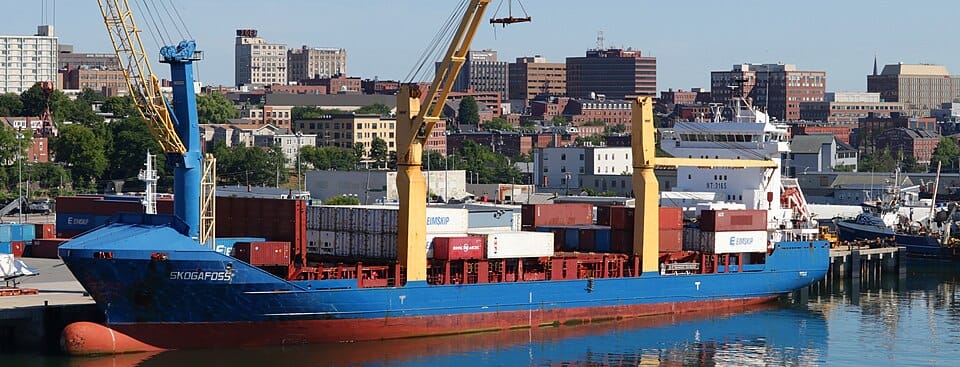
Why? Well, soccer stadiums can operate anywhere. Cargo ships, barges, trawlers, and tugboats cannot. Nor can the longshoremen and women, stevedores, harbor pilots, and deckhands who service them. They need deep water ports, which is what the western waterfront provides.
As background, a couple weeks ago, the Hearts of Pine announced they had put Cassidy Point, the westernmost corner of our waterfront, under contract to build an 11,000 seat soccer stadium. That sale is contingent on the city approving a carveout to our longstanding protections for marine-based freight and industrial uses, which need access to the deep water of the harbor.
The zone was first put in place in the late 1980’s after a developer transformed Central Wharf into a string of 150+ high-end condos (now called Chandler’s Wharf). The backlash to that development led to a citizen referendum in which Portlanders voted 2-1 to freeze all non-marine development on the water side of Commercial street.
That zoning has been modified carefully over the years, and only after extensive input from those working the piers. Those modifications have allowed for a certain percentage of non-marine uses, mostly on the upper floors of old or new structures, in order to provide some economic diversity.
Overall, the amount of space in Portland that marine business can use is decreasing. But for the western half of the waterfront, where the Hearts of Pine want to build their stadium, there’s been some real growth in marine industries.
Eimskip, a shipping company, moved into the International Marine Terminal at the beginning of the western waterfront in 2013. Around the same time, Portland Yacht Services turned 23 acres of what was fallow land into a thriving boat restoration and storage business. And between those two sites, a massive cold storage facility was built.
This has meant hundreds of new good-paying jobs, doing exactly the work that can only be done on the waterfront. A real success story of how protecting land for its best community use, not simply its most profitable return for an investor, can help everyone.
But Cassidy Point was recently purchased by a multi-billion dollar out-of-state hedge fund. Those investors have reportedly been trying to make a quick buck by flipping it. Apparently, both the Maine Port Authority and Eimskip had been interested in buying it before the hedge fund, because they had wanted to expand commercial shipping to that area.
But my guess is the hedge fund managers know that if they could find a buyer who would seek to rezone the property out of its protected status, they could exponentially maximize their profit (some estimates say eliminating its protected status inflates the value ten times). That’s where the Hearts of Pine came in.
When I was mayor, Portland developed a comprehensive plan where groups from all across the city came together to discuss what we wanted to see for Portland by 2030. Fully 91% of Portland residents surveyed at the time supported “continued protections for Portland’s working waterfront.” That is why two of the plan’s major goals for the waterfront are the “ … mitigation of market trends that could compromise the balance between marine industries and competing development,” and “recognize and reinforce waterborne transport of goods and people as foundational to our community.”
Even in our most recent overhaul of our building code, the waterfront protection zone, in its entirety, was kept intact.
So, what to do? Clearly we love our soccer team. And if the owners want to spend their own money building a new stadium, they certainly have that right. But, as I said above, soccer stadiums can go anywhere. They could put it out on Riverside Street (hey, if it is good enough for our homeless shelter, it should be good enough for soccer). Or maybe next to 295, just up from Cassidy Point, where there are huge swaths of land near going unused. The Hearts of Pine owners said they actually looked at 12 viable sites.
But wherever it goes, it should not go on the waterfront. Supporting the home team matters, but in this case, the home team I side with are the women and men who need the waterfront to make a living.
***
This story was originally published by The Beacon, a nonprofit and nonpartisan news organization. To get regular coverage from the Beacon, sign up for the free Beacon newsletter here.